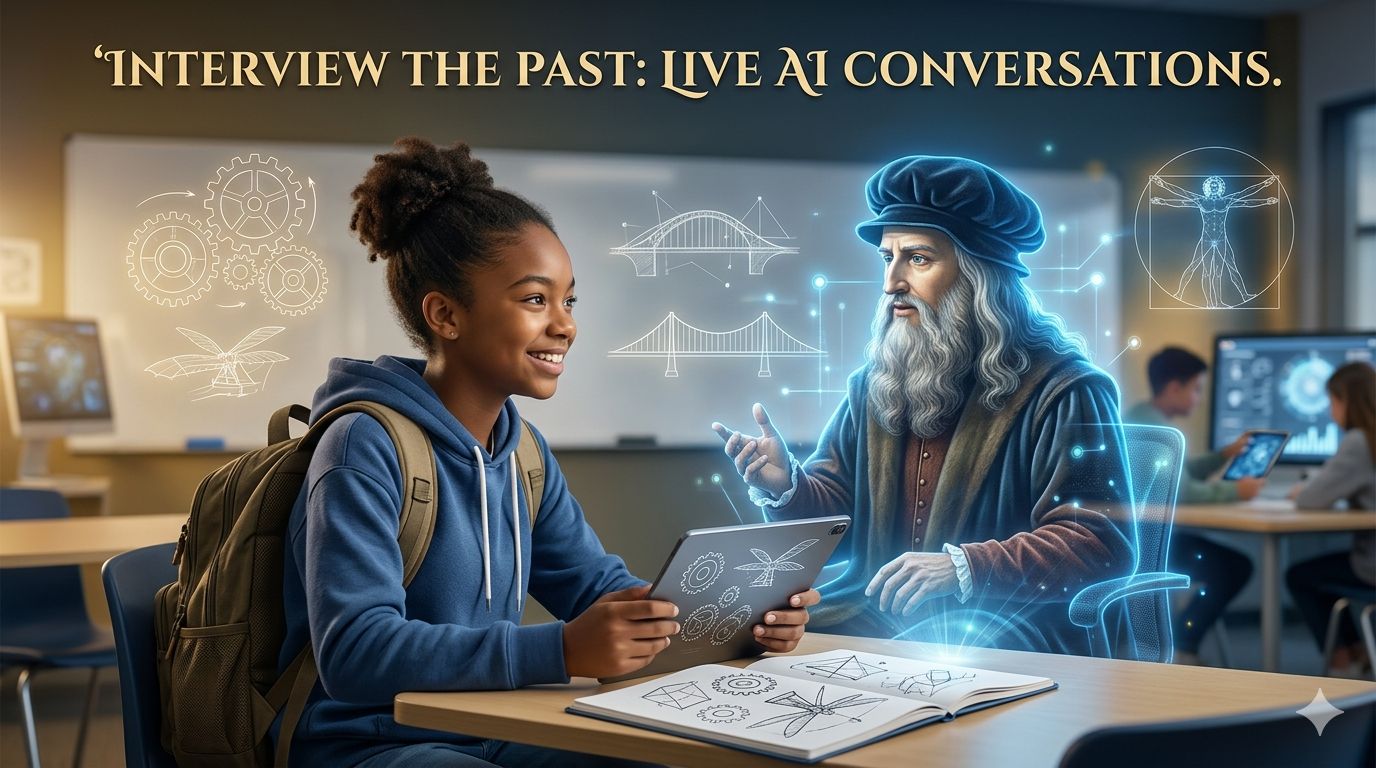
Imagine your students debating the ethics of the steam engine with James Watt, or asking Rosa Parks about the morning of the Montgomery Bus Boycott.
In 2026, this isn’t science fiction—it’s a Tuesday morning lesson plan. But simply giving students a chatbot isn’t enough; you need a structured “Inquiry Framework” to ensure they are learning history, not just playing with a toy.
The Top 3 Tools for 2026
1. Humy.ai (The Educator’s Choice)
Formerly known as Hello History, Humy.ai has become the #1 platform for social studies. It features 1,200+ pre-trained figures that are “safety-locked” for the classroom.
- The 2026 Update: It now supports Live Voice Conversation. Students can actually hear the figure speak in a historically accurate accent and tone.
- Best Feature: Teachers get a dashboard to see every conversation, ensuring students stay on task.
2. Character.ai (The Creative Sandbox)
While more “open” than Humy, Character.ai allows students to build their own historical figures—a powerful project-based learning (PBL) activity.
- The Lesson Idea: Assign each student a figure. Their job is to “train” the AI by feeding it primary sources, quotes, and diary entries until the bot “sounds” like the person.
- Best Feature: It’s free and highly customizable for niche historical figures.
3. OpenEduCat: AI Historical Timeline
This is for advanced causal analysis. It creates a “Web of Causation.”
- How it works: Instead of just chatting, the AI generates a timeline where each event is linked to a person. Students can “click” into the person to understand why they made a specific decision.
- Best Feature: Excellent for AP and IB History students who need to understand “Perspective” and “Causality.”
4-Step Lesson Plan: The “Press Conference”
Don’t just let students “chat.” Give them a role.
- The Research Phase: Students must find three primary sources about their figure before they open the AI.
- The Interview: Students act as “Journalists from the Future.” They must ask three questions that the figure couldn’t have known the answer to (e.g., asking George Washington what he thinks of modern political parties).
- The Fact-Check: Students must find one “Hallucination.” AI isn’t perfect; students get a “Bonus Point” if they find a claim the AI made that contradicts their research.
- The Reflection: Students write a short paragraph: “How did the AI’s ‘personality’ change how I feel about this historical event?”
Comparison: Safety vs. Immersivity
| Tool | Safety Level | Accuracy | Best For… |
| Humy.ai | ⭐⭐⭐⭐⭐ | High | Grades 4–10 (Classroom Safe) |
| Character.ai | ⭐⭐⭐ | Variable | Grades 9–12 (PBL Training) |
| OpenEduCat | ⭐⭐⭐⭐ | High | AP/IB Students (Deep Analysis) |